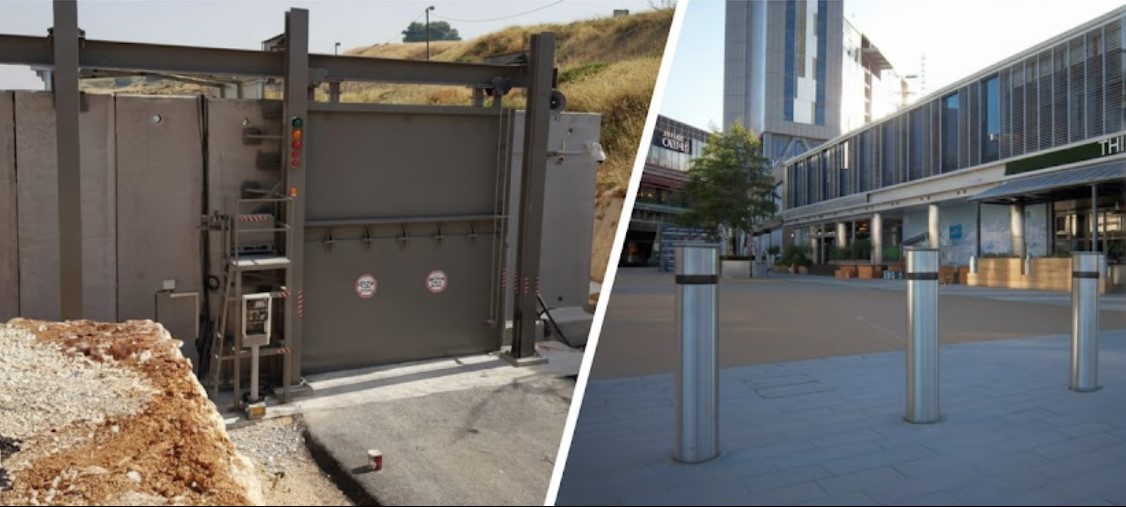


Security bollards are an effective way to protect buildings, entrances, pedestrian areas, parking zones, and sensitive infrastructure from unauthorised vehicle access. However, not every property requires the same type of bollard.
The correct selection depends on the level of protection required, the site layout, vehicle movement, appearance, and access-control needs.
What is a security bollard?
A security bollard is a vertical post installed to control or prevent vehicle movement. Depending on its design, it may be fixed, removable, automatic, or crash-rated.
Bollards can be used to protect people and property while still allowing authorised vehicles to access designated areas.
Main types of security bollards
Fixed bollards
Fixed bollards are permanently installed in the ground. They are suitable for protecting building entrances, pedestrian walkways, storefronts, perimeters, and restricted zones.
They are a practical choice when vehicle access is not required through the protected area.
Automatic rising bollards
Automatic bollards rise and retract using hydraulic, electromechanical, or pneumatic mechanisms. They allow authorised vehicles to enter while keeping restricted areas protected at other times.
They are often used at corporate entrances, government facilities, hotels, residential developments, and high-security sites.
Removable bollards
Removable bollards can be taken out when occasional vehicle access is needed. They may be suitable for event venues, service entrances, pedestrian plazas, and flexible access zones.
Crash-rated bollards
Crash-rated bollards are engineered to resist vehicle impact. They are designed for locations where hostile vehicle attacks, accidental collisions, or forced entry are significant concerns.
Crash performance should always be assessed using applicable testing and certification details rather than appearance alone.
How to select the correct bollard
Assess the security risk
Start by identifying the threat. Is the objective to guide traffic, prevent casual parking, protect pedestrians, or resist a deliberate vehicle impact?
A decorative bollard may be sufficient for traffic guidance, whereas a critical facility may require a crash-rated or automatic security bollard.
Study vehicle movement
Consider the type and size of vehicles that approach the site. Delivery trucks, emergency vehicles, cars, and heavy commercial vehicles create different design requirements.
The bollard arrangement should also provide sufficient clearance for authorised vehicles.
Check the access-control requirement
If the site requires controlled entry, automatic bollards can be integrated with access-control systems. If vehicle access is not required, fixed bollards may offer a simpler and more economical solution.
Consider the environment
Outdoor bollards may be exposed to rain, dust, humidity, vehicle fluids, and temperature changes. Material selection, drainage, corrosion resistance, and maintenance access should be reviewed before installation.
Plan for emergency access
Emergency release and manual override functions are essential for many automatic systems. The security design should allow authorised emergency vehicles to enter quickly when required.
Common applications
Security bollards are used at:
- Banks and financial institutions.
- Hotels and luxury properties.
- Airports and transport hubs.
- Government buildings.
- Defence installations.
- Corporate offices.
- Retail entrances.
- Data centres.
- Religious and heritage sites.
BGI Engitech’s product range includes fixed, automatic, and crash-rated bollard solutions for a variety of perimeter-protection requirements.
Conclusion
The best security bollard is not necessarily the largest or strongest model. It is the model that matches the site’s risk level, traffic pattern, access requirements, installation conditions, and operational needs.
Suggested CTA:
Need help selecting the right bollard? Speak with BGI Engitech for a site-specific recommendation.